When executions become normalized and activism turns into performance a look at three important international films:

Why do so many of our political actions and forms of activism seem to have a greater impact on social media than on power itself?
Perhaps the reason is that we are not as honest with ourselves in our confrontation with power as we would like to believe. A regime may arrest us for a criticism, a statement, or a small act of dissent. After our release, the same thing may happen again, creating a cycle of arrest, release, and arrest once more. But does this repetition necessarily mean that we have become extraordinarily important political actors? Or is it simply a reflection of the nature of a totalitarian system that cannot tolerate criticism and sees imprisonment as its easiest response?
Perhaps we still do not fully understand the nature of power—or perhaps we do not want to.
Within the cycle of arrest and release, a public image is often created: the image of a dissident, a fighter, a symbol of resistance. Opposition media outlets naturally report arrests and political persecution. If an individual has stronger media connections, a larger network, or closer relationships with journalists and activists, their story may receive greater attention. Yet the visibility of one political prisoner and the invisibility of another does not determine the importance of their struggle.
Many political prisoners have suffered in obscurity for years without ever becoming headlines. Likewise, many victims of execution in Iran have lost their lives before their names were ever widely known. Media attention is not always determined by the significance of an issue; it is often shaped by cycles of attention, personal networks, and the economy of visibility.
Just as we must understand the nature of power, we must also understand the nature of media.
But the more troubling issue lies elsewhere.
Among some individuals who have become prominent within media cycles and present themselves as advocates of justice, democracy, and freedom, there are sometimes monsters hidden behind the mask of righteousness—people who speak the language of liberty while contributing little to freedom, democracy, solidarity, or collective action.
In some respects, these figures can become even more dangerous than power itself.
Power does not offer hope. People understand that they are trapped within a system of repression and that the possibilities for change are limited. But these figures operate through emotion. They speak of freedom, justice, human rights, and a better future. They create hope. They present themselves as the voice of society.
But what do they actually do?
Do they build networks for solidarity and cooperation?
Or do they build networks for access, influence, media privilege, and acceptance within exclusive circles?
Have they created trust among different groups?
Or have they merely built closed communities that continuously exclude others?
Some of these individuals may themselves be arrested again and once again become media headlines. Yet the point is not how many times someone has been arrested.
The real questions are these:
Have we challenged the very logic of power through our actions, our ethics, and our behavior?
Have we forced those in authority into positions of accountability?
Have we succeeded in bringing together activists, intellectuals, artists, workers, women, and minorities?
Or have we simply transformed arrest and imprisonment into a form of political performance?
The issue of executions offers one of the clearest examples.
For years, families seeking justice, political prisoners, human rights defenders, and international anti-execution campaigns have worked tirelessly. Yet power continues to rely on executions and gradually turns them into an ordinary feature of political life.
This may be one of the most important questions of our time:
Why, despite countless campaigns, statements, reports, and media coverage, have we failed to make execution morally unacceptable within public consciousness?
Why can a government continue to execute people week after week, month after month, while society experiences a brief moment of outrage and grief before returning to normal?
Perhaps part of the answer is that we are often competing for visibility rather than confronting structures of power.
Power is not afraid of headlines.
Power is afraid of a society with social trust.
Power is afraid of people who can cooperate with one another.
Power is afraid of solidarity.
Power is afraid of communities that value human life more than death and execution.
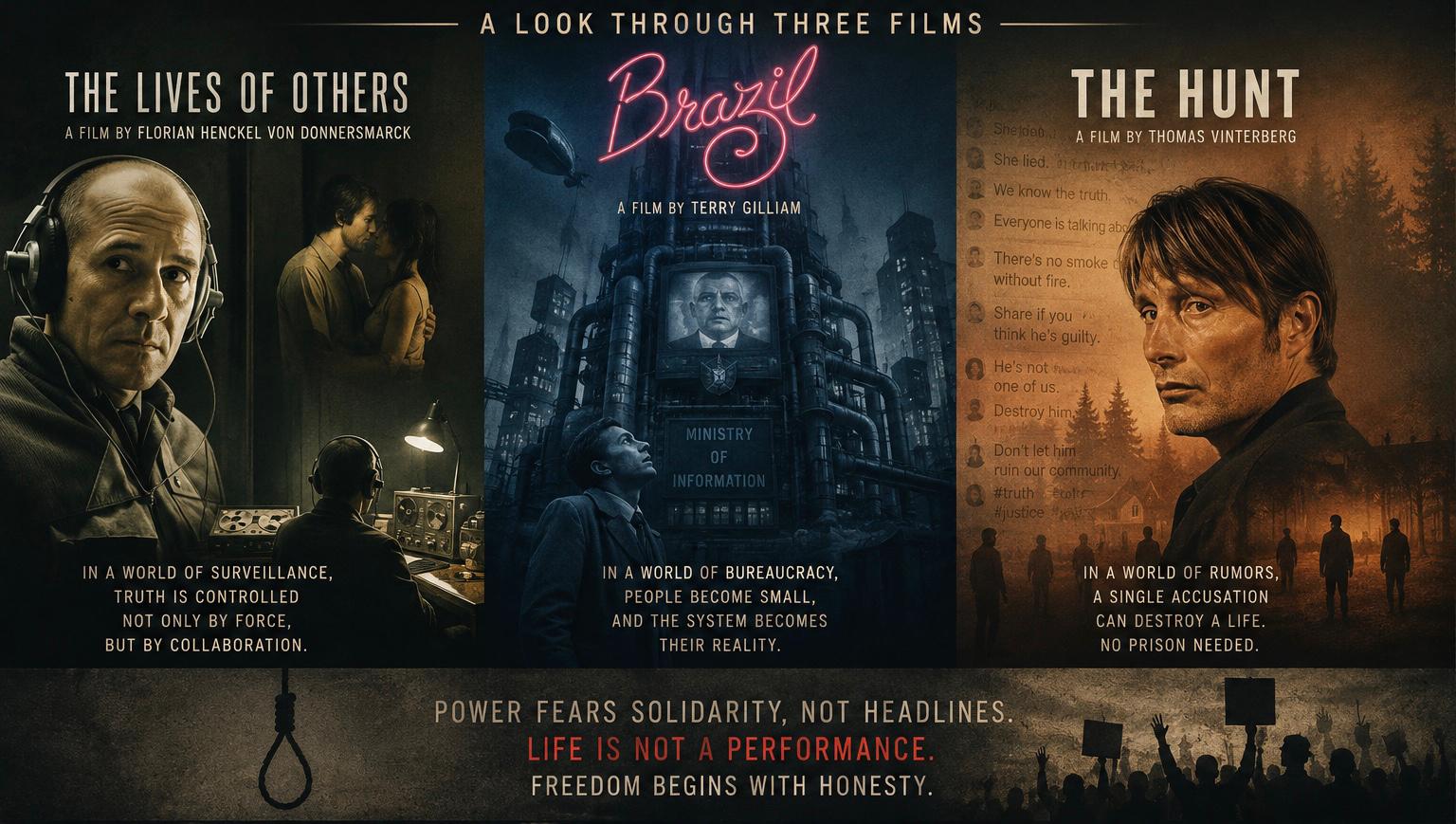
Cinema has explored these realities with remarkable clarity.
In The Lives of Others, we see that authoritarian systems do not operate solely through prisons and arrests. They rely on networks of surveillance, compliance, and intellectual participation to control truth itself.
In Brazil, bureaucracy and power become so pervasive that ordinary people unknowingly become parts of the machinery of oppression.
In The Hunt, we witness how a society can destroy a human being without prisons or torture—through rumors, labeling, exclusion, and collective suspicion.
Perhaps the greatest danger in authoritarian societies is not official power alone, but the reproduction of the same logic of exclusion, vanity, monopolization, and domination among those who claim to oppose power.
If we are not honest about justice in our private lives, if we do not practice freedom in our daily relationships, if we silence those who disagree with us, and if we use the suffering of others to build personal political brands, then no matter how often we speak of freedom, we may be rebuilding the very monster we claim to fight.
Perhaps freedom begins when we stop turning arrest and imprisonment into symbols of heroism and instead ask ourselves:
Does my behavior reflect the world I claim to be fighting for?
Author’s Note
I have written this text based on my lived experience, years of confronting power, imprisonment, observing political and civil activists, studying the history of power, and reflecting on both social media and real-life political environments, as well as the lessons offered by cinema and film history.
My intention is not to create despair, passivity, or to dismiss the efforts of those who genuinely work for freedom, justice, and human rights. On the contrary, I believe that every meaningful social transformation requires courageous, committed, and responsible individuals.
At the same time, I believe that achieving freedom requires us to see power as it truly is and to speak honestly about its realities. Just as we must criticize repression, imprisonment, executions, and structural violence, we must also remain vigilant against the reproduction of power’s logic exclusion, monopoly, patronage, narcissism, and the pursuit of visibility—among those who oppose it.
If we fail to critically examine our own behavior, choices, and political culture, we may unintentionally recreate the very structures we have spent years resisting.
This essay does not claim to offer absolute truth. It is simply an attempt to raise questions about the relationship between power, media, justice, activism, and freedom.
Because I believe that the first step toward building a better future is the willingness to see reality clearly and to speak truthfully about it even when that truth is difficult to hear.